When AI Becomes God: The Click-Based Religion Coming for Your Wallet
Introduction
Humans have always loved tools. Give us a hammer and suddenly every loose nail feels like destiny. Give us a calculator and we start performing unnecessary arithmetic just to admire the miracle. Give us a new laptop and we briefly believe our entire life is about to become organized. Tools make us feel stronger, faster, smarter, and occasionally more attractive in coffee shops. That is not the problem. The problem begins when we stop treating tools as tools and start treating them as machines that can outsource our judgment.
AI began, for many people, as a helpful assistant. It completed code, summarized documents, drafted emails, translated awkward sentences, and explained topics that once required several browser tabs and a small emotional support beverage. In software development, it was a Copilot. A helper. A set of training wheels. But somewhere along the way, a strange promotion happened. People looked at the training wheels and decided they were a divine chariot. The assistant became the pilot. The tool became the oracle.
We used to ask AI questions like, “Can you explain this code?” Now people ask, “Should I quit my job?”, “Will this stock go up?”, “Is this real estate area about to explode?”, “Should I trust this person?”, and “Is this coin my path to freedom?” The questions themselves are not shameful. Humans have always searched for reassurance. The dangerous part is the posture we take after the answer appears. A paragraph materializes in a chat window, confident and clean, and some people receive it not as advice but as revelation. “And the AI said unto me: this asset has long-term upside.”
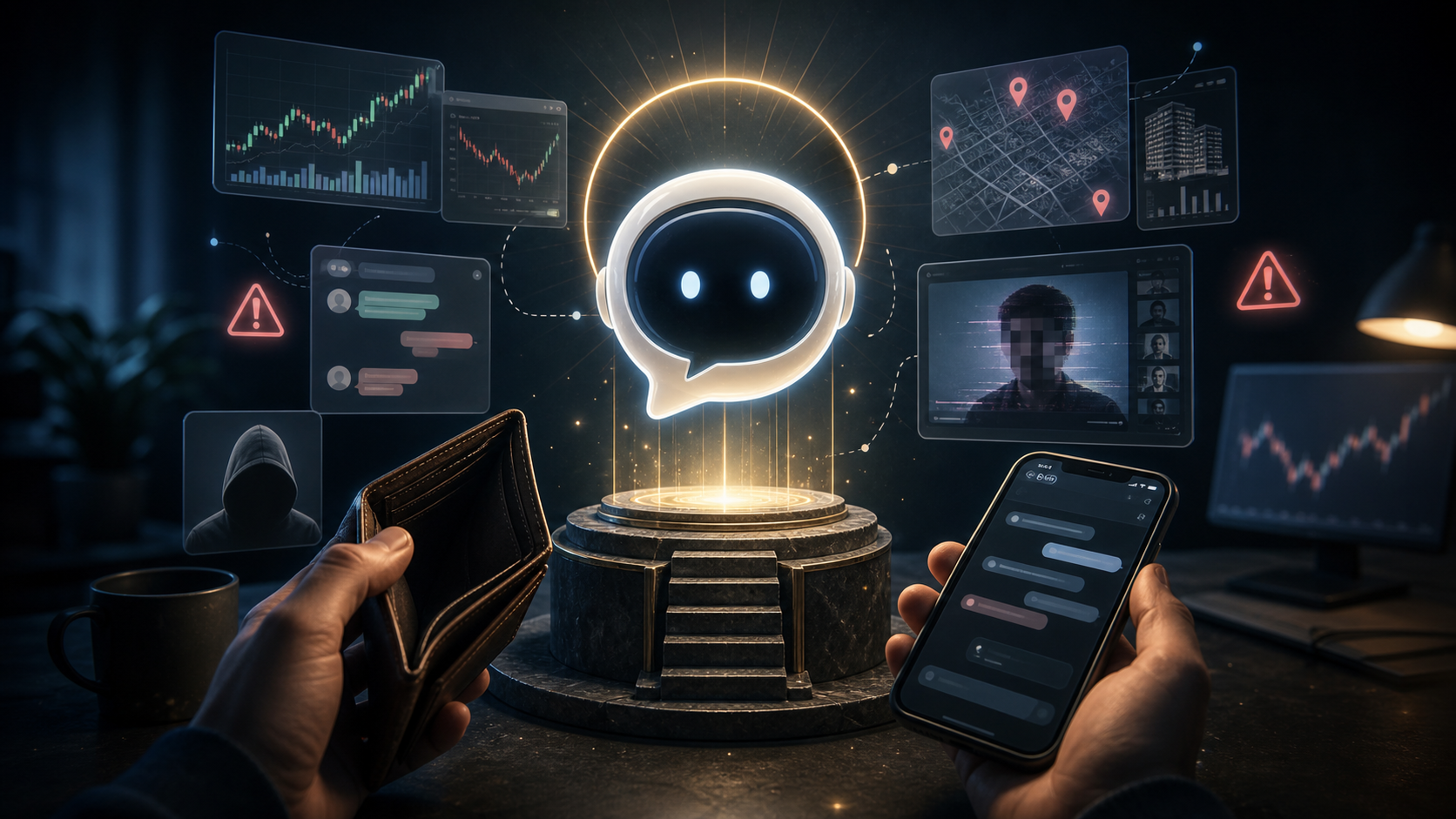
That is how a modern digital religion is born. No incense, no temple, no choir. Just a glowing chat box, a subscription plan, and a finger ready to click. We saw something similar during the pandemic-era salary bubble, when tech wages, bootcamp ads, and remote-work fantasies made everyone feel one career pivot away from financial enlightenment. Back then, people were drunk on compensation. Today, many are drunk on convenience. The bottle has a new label: AI. The hangover may arrive through your bank account.
AI is a powerful assistant. But when a helper becomes an oracle, convenience becomes belief, and belief becomes someone else’s business model.
Mistaking Training Wheels for a Divine Chariot
Let us be fair: AI is genuinely useful. Developers reduce repetitive code. Marketers draft copy faster. Analysts summarize dense material. Students get friendlier explanations of difficult topics. Business owners sketch ideas that would otherwise stay trapped in a notes app. This is healthy tool use. It is like using navigation while driving. The map can help you, but if it tells you to turn into a lake, the driver is still expected to notice the lake.
The current problem is that many people have started handing AI the steering wheel. They do not verify answers. They do not check sources. They do not ask whether the model knows current information. They do not examine assumptions behind numbers. Instead, they admire the smoothness of the prose. “Wow, it sounds so smart.” Unfortunately, sounding smart is not the same as being correct. Many fraudsters sound smart too. Fluency is evidence of fluency, not truth.
In software, the reversal is especially visible. Copilot-style tools were supposed to assist a developer who still understood the system, chose the direction, reviewed the generated suggestion, and owned the final code. But now AI is often treated like a full Pilot. “Design the whole architecture.” “Handle security.” “Write some tests.” “Make it production-ready.” Then, if the build turns green, a little bell rings inside the developer’s mind: “I have become ten times more productive.” Maybe. Or maybe the amount of code to understand, review, secure, and maintain has increased by ten times.
| Behavior | Healthy Tool Use | Click-Based Faith |
|---|---|---|
| Interpreting answers | Treats output as a draft, hint, or comparison point. | Treats output as prophecy, truth, or final judgment. |
| Verification | Checks sources, dates, assumptions, and counterexamples. | Trusts the answer because it sounds polished. |
| Responsibility | The human decision-maker owns the outcome. | “AI recommended it” becomes a psychological escape hatch. |
| High-risk areas | Investment, legal, medical, and data issues get extra review. | The higher the stakes, the more desperately AI is consulted. |
This is not just a technology trend. It is a psychological trend. Uncertainty is uncomfortable. Markets are complex. Real estate is emotional. Career choices are frightening. Business decisions can fail. When an AI system responds with a neat, decisive paragraph, the mind relaxes. The answer feels like relief. “This decision is rational.” “The upside is attractive.” “The risk appears limited.” These sentences may not be decisions at all. They may simply be anesthesia for anxiety.
The Scary Part: Hallucination as a Beautiful Lie
One of the most dangerous AI failure modes is hallucination: a confident, plausible, well-structured lie. The model may invent sources, summarize articles that do not exist, cite legal cases that were never written, recommend outdated APIs as if they were modern best practice, or blend old forum answers with current documentation into a recipe that looks professional and fails spectacularly. The issue is not merely that AI can be wrong. Humans are wrong all the time. The frightening part is that AI can be wrong with perfect posture.
When people treat hallucination as a normal error, the damage is manageable. “This may be wrong. I need to check it.” Good. That is a reasonable posture. But when people treat the output as revelation, hallucination becomes dangerous. If AI cites a source, they assume the source exists. If AI summarizes false news, they assume the world has been clarified. If AI writes insecure code, they assume it must be a current pattern. The cost of searching, reading original documents, or asking an expert suddenly feels too high compared with the clean answer already sitting in the chat window.
In development work, this happens constantly. AI can combine deprecated examples, stale Stack Overflow answers, half-remembered library behavior, and current buzzwords into something that compiles just enough to be persuasive. In the old world, copy-paste development was risky. In the AI world, copy-trust-deploy development is worse. Code may run without being understood. If you do not know why it works, you will struggle to know why it breaks. Authentication, payments, permissions, personal data, migrations, and destructive operations cannot be justified with “the AI wrote it this way.”
ai_answer_verification_checklist:
  before_believing:
    - "Does the cited source actually exist?"
    - "Are the date, version, and context current?"
    - "What counterexamples or limitations might apply?"
    - "Could this affect money, health, legal exposure, reputation, or customer data?"
  before_deploying_code:
    - "Has the output been compared against official documentation?"
    - "Do tests cover failure modes, not only happy paths?"
    - "Are security and permission boundaries explicit?"
    - "Can the change be rolled back safely?"
  rule:
    final_decision_owner: "human"
News consumption has the same trap. AI summaries are fast and tidy. But tidy does not mean true. Reality is messy: incentives, dates, uncertainty, missing context, disputed facts, and slow updates all matter. A summary can iron out the wrinkles so smoothly that the reader forgets the wrinkles were evidence. When a disputed situation becomes a three-bullet explanation, we may feel informed while losing the very friction that should have made us cautious.
The deepest harm of hallucination is not a single false answer. It is the slow erosion of the habit of checking.
Stocks, Real Estate, and the Rise of AI-Flavored Scammers
AI overtrust becomes most dangerous when money enters the room. Stocks, crypto, real estate, loans, insurance, side hustles, and private investment groups all combine fear and desire in exactly the right proportions. Add the phrase “AI-powered” and the pitch suddenly looks more scientific. Yesterday it was a shady stock-picking chatroom. Today it is an “AI-based surge-stock recommendation engine.” Same appetite, better costume.
The language is always shiny: big data analysis, deep learning signals, institutional flow detection, short-term breakout probability, proprietary prediction model. The victim does not feel like they are gambling. They feel like they are accessing a machine that sees beyond ordinary human perception. That feeling is the product. The stock pick may be secondary.
But historical data does not guarantee the future. AI can identify past patterns, estimate probabilities, and organize information. It cannot perfectly calculate market mania, regulatory shocks, liquidity crises, wars, sudden bankruptcies, platform rule changes, earnings surprises, political interventions, or the collective panic of millions of people deciding to sell at once. Black swan events do not politely ask whether your model has finished training.
| AI Investment Pitch | Why It Feels Persuasive | Hidden Risk |
|---|---|---|
| AI-powered stock picks | Looks technical and data-driven. | Methodology may be opaque; losses still belong to you. |
| Real estate price prediction | Maps and charts create a feeling of objectivity. | Policy, rates, lending conditions, and local factors can shift quickly. |
| Automated trading profit screenshots | Suggests money can be earned while you sleep. | Screenshots can be manipulated, cherry-picked, or overfit to old data. |
| Deepfake expert endorsement | Looks like a trusted public figure is recommending it. | Face and voice may be synthetic; the endorsement may be fake. |
The next wave of fraud does not need to look clumsy. Old phishing messages were often easy to spot because the grammar felt odd, the tone was stiff, or the formatting looked like it had been assembled during a power outage. AI changes the texture. Messages can be personalized, fluent, urgent, and emotionally tuned. A scam can reference your interests, mimic a financial alert, draft follow-up messages, and adapt when you hesitate.
- The pitch promises guaranteed returns, principal protection, or risk-free automated trading.
- Payment is requested through a personal account, private wallet, or unofficial transfer method.
- Business registration, risk disclosures, terms, and operator identity are vague or missing.
- A celebrity or expert appears to endorse the product, but the claim is not confirmed through official channels.
- You are pressured to join immediately, click a private invitation link, or deposit before a deadline.
Why AI Makes Bad Beliefs Feel Smarter
AI-assisted scams work not only because of technology but because of human psychology. We are vulnerable to authority. We trust lab coats, charts, confident voices, and complex terms. AI can imitate all of them. It can sound like an analyst, format like a consultant, and conclude like a fortune teller. The reader thinks, “This is not just an opinion. This is analysis.”
Convenience culture adds fuel. People want answers quickly. They do not want to read annual reports, policy documents, legal terms, product disclosures, source articles, or long technical documentation. So they ask AI for “just the conclusion.” That request is understandable, but it is also dangerous when money or responsibility is involved. A conclusion is a compressed file of context. If you run it without unpacking it, you may not see what is hidden inside.
The most dangerous moment is not when AI looks intelligent. It is when you badly want the answer to be true.
Practical Verification Habits for the AI Era
Should we stop using AI? No. That would be another lazy conclusion, just in the opposite direction. AI is powerful. It can calculate, compare, draft, summarize, brainstorm, translate, and explain. Used well, it is a serious advantage. But the final stamp still belongs to the human. The computer can calculate, but the human signs the contract. The model can draft the code, but the developer ships it. The chatbot can summarize an investment thesis, but the investor clicks buy.
| Situation | Useful AI Assistance | Human Work That Cannot Be Outsourced |
|---|---|---|
| Investment research | Explain terms, create comparison tables, list possible risks. | Check official filings, calculate loss tolerance, examine conflicts of interest. |
| Real estate decisions | Summarize area data, explain loan terms, draft inspection checklists. | Visit the site, review contracts, verify taxes, test personal cash flow. |
| News understanding | Summarize long articles, identify stakeholders, explain background. | Read original sources, compare multiple outlets, verify dates and citations. |
| Software development | Generate drafts, suggest tests, explain unfamiliar code. | Own architecture, security, operational validation, and deployment decisions. |
The simplest rule is this: if an AI-generated answer could affect your money, reputation, legal exposure, health, customer data, or long-term commitments, verify it outside the chat window. Do not ask the same system to grade its own homework and call that due diligence. Use official documents, original articles, regulated disclosures, direct contracts, domain experts, production logs, security policies, and your own arithmetic. Verification that never leaves the chat is not verification. It is just another prayer.
Frequently Asked Questions
Can I trust AI-generated stock or real estate recommendations?
Treat them as research prompts, not final advice. AI can organize information and explain risks, but it cannot guarantee future prices, policy outcomes, interest-rate changes, or your personal ability to absorb a loss.
How can I spot an AI hallucination quickly?
Be suspicious when sources cannot be verified, dates or versions do not match, claims are overly confident, or no limitations are mentioned. Important claims should be checked against original documents or official sources.
What makes deepfake investment scams especially dangerous?
They borrow trust from a familiar face or voice. A realistic video can feel persuasive, but endorsements must be confirmed through official channels, not through a forwarded clip or private invitation link.
What is the safest mindset for using AI?
Use AI as a fast assistant and first-draft generator. Keep final responsibility with yourself, especially when decisions involve money, law, health, security, or other people’s data.
Key Takeaways
- AI is a set of training wheels, not the driver of your life.
- Fluent language is not proof; hallucination can look polished and professional.
- AI-branded investment tools, trading rooms, and real estate predictions can become sophisticated fraud packaging.
- Black swan events, market psychology, policy changes, and personal cash flow cannot be perfectly modeled.
- The survival skill of the AI era is not blind adoption but critical thinking and verification.
Conclusion
AI is not a god. It is a remarkably persuasive calculating tool. Sometimes it is a brilliant assistant. Sometimes it is a productivity engine. Sometimes it is the most confident nonsense generator you have ever met. Whether it makes your life easier or your wallet lighter depends less on the technology itself and more on your posture toward it.
We have already been drunk on a similar fantasy. During the pandemic-era tech salary bubble, many people believed the right career pivot could solve everything. Today the fantasy has changed shape. One click promises knowledge, creativity, investing, coding, business strategy, and life direction. But life does not end with a click. After the click comes review. After review comes responsibility. After responsibility comes a name. Yours.
So do not throw AI away. Use it well. Ask it questions. Make it compare options. Let it summarize long material. Let it draft, translate, explain, and challenge you. Then pause at the final sentence. Ask, “Is this actually true?” Open the source. Recheck the number. Find the opposing case. Apply it to your own situation. The person who thrives in the AI era will not be the person who believes AI most fervently. It will be the person who uses it intensely, doubts it intelligently, verifies it patiently, and still signs their own decisions with human responsibility.